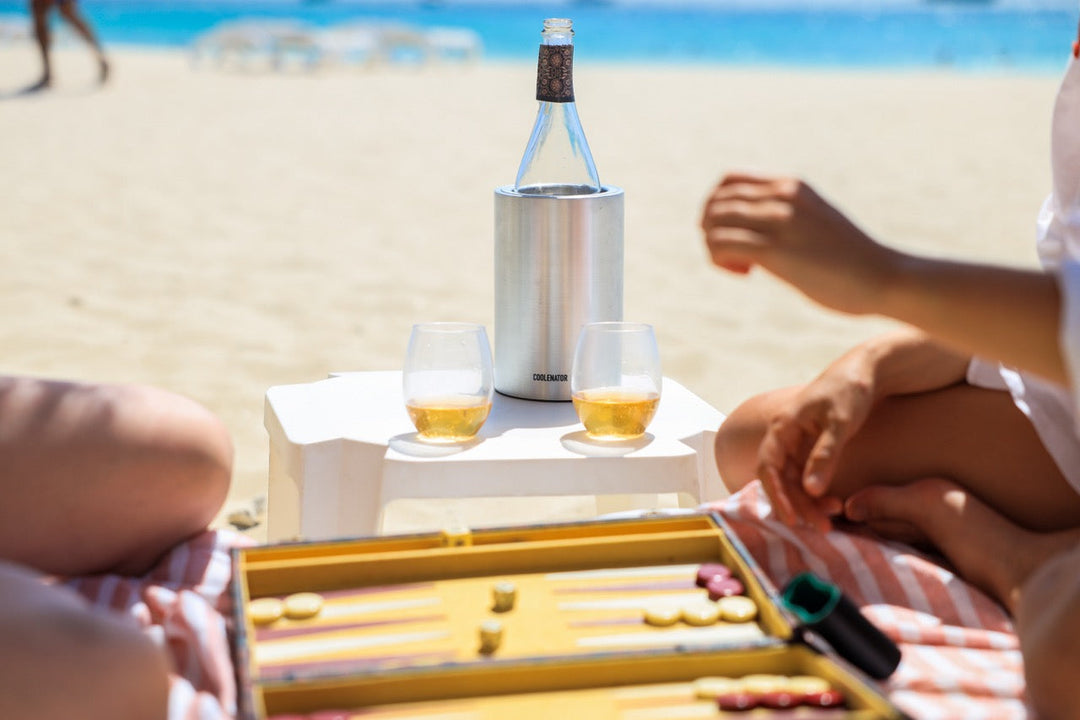





Short answer: To keep wine cold outside without ice, chill the bottle in the fridge first, then place it in an insulated bottle cooler that uses a pre-frozen cooling core instead of ice - such as a Coolenator. In in-house testing with a calibrated digital probe, a Classic Coolenator kept a served 750 ml wine bottle below 8 °C for a full 6 hours at 20–22 °C ambient temperature, using no ice, no water and no electricity.
Ice is the wrong tool outdoors. It melts in the sun, leaves the bottle dripping wet, needs constant topping up, and the meltwater dilutes nothing but your patience. A freezer-bullet cooler solves all three problems at once. Here is how to keep your wine perfectly chilled outside, step by step.
Why ice doesn't work well outdoors
- It melts fast. In warm ambient temperatures ice turns to water quickly, so cooling power fades exactly when you need it most.
- It makes a mess. A dripping, sweating bottle is awkward to pour and ruins labels, tablecloths and picnic blankets.
- It needs a supply. No freezer nearby means no refills — a real problem at the beach, in the park or on a boat.
How to keep wine cold outside without ice, step by step
- Freeze the cooling bullet first. Place the removable Coolenator freezer bullet in your freezer for at least 9 hours - ideally overnight or longer. In testing, the bullet reached full solidification after about 9 hours at −18 °C. A colder, more stable freezer and a spot near the back or bottom shelf freeze it fastest.
- Pre-chill the wine. Start with a bottle already cooled in the fridge (around 6–8 °C). The cooler maintains and deepens the chill — it is not meant to cool a warm bottle from scratch.
- Twist the frozen bullet into the base and drop the bottle into the insulated sleeve. A standard (Regular) Coolenator fits a 750 ml wine or champagne bottle; the Tall model takes taller bottles.
- Serve and re-seat. Return the bottle to the cooler between pours to keep warm air out and stretch the cold as long as possible.
How long does wine stay cold in a Coolenator?
In a controlled six-hour test, a Classic Coolenator was measured with a calibrated digital probe inside a two-thirds-full 750 ml wine bottle that started at 8 °C, at an ambient room temperature of 20–22 °C. The wine cooled to its lowest point (around 0.7 °C) after roughly two hours and stayed below 8 °C for the full six hours — living up to the idea that your last sip is colder than your first.
Test conditions: Classic Coolenator · 750 ml bottle, ⅔ full · 8 °C start · 20–22 °C ambient · readings every 30 minutes with a calibrated digital probe thermometer.
Real-world results vary with ambient heat, the bottle's starting temperature, fill level and how often you take it out.
Which Coolenator fits my bottle?
- Regular / Classic Coolenator - 20 cm tall, fits a standard 750 ml wine or champagne bottle.
- Tall Coolenator - 30 cm, for taller bottles.
- Tall Turbo (double bullet) - extra cooling mass for warmer conditions.
Frequently asked questions
Do I need ice or water with a Coolenator?
No. The cooling comes entirely from the pre-frozen freezer bullet. There is no ice, no water and no electricity involved.
How long should I freeze the bullet?
At least 9 hours at −18 °C; overnight or longer is always better and gives more cooling hours.
Can it cool a warm bottle?
It is designed to maintain and extend an existing chill, so start with a bottle from the fridge for best results.
Does it work for champagne?
Yes - a standard 750 ml champagne bottle fits the Regular Coolenator.
Ready to ditch the ice bucket? Explore the Classic Coolenator and keep every glass cold, outdoors or in.